The Pawn Structure Terms Behind the Number
Doubled, isolated, backward, passed, hanging. What each costs in an evaluation, why some of them are worth having, and which one is usually mispriced by humans.
· 4 min read
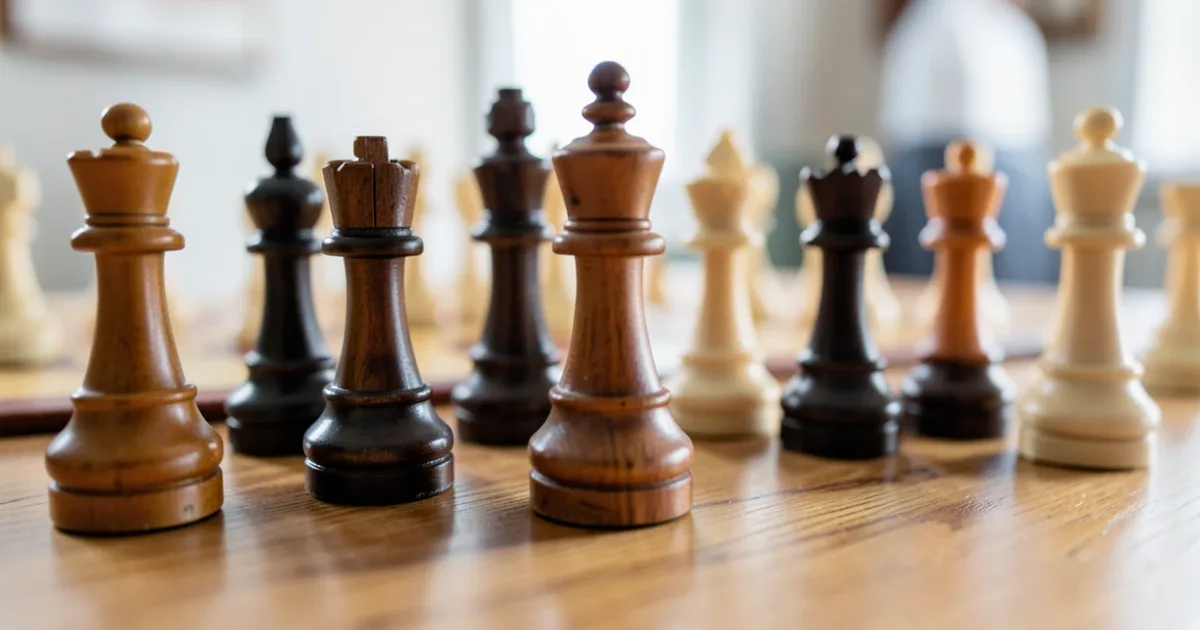
Structural terms are the vocabulary of positional chess, and they are also literal terms in an engine's evaluation, each carrying a number. Knowing roughly what each is worth explains a good deal of what looks arbitrary in an assessment.
The main ones, and their rough cost
| Structure | Typical cost | The compensation |
|---|---|---|
| Doubled pawns | 0.2 to 0.3 | An open file, central control |
| Isolated pawn | 0.2 to 0.4 | Two open files, an outpost, space |
| Backward pawn | 0.2 to 0.3 | Usually little; the worst of the group |
| Hanging pawns | Varies wildly | Enormous space when they advance |
| Passed pawn | A bonus, not a cost | Grows sharply by rank |
The passed pawn bonus is the one that scales most dramatically. A passed pawn on the fourth rank is worth a fraction; on the sixth it can be worth a piece; on the seventh it frequently decides the game outright. That scaling is why endgame evaluations move so sharply when a pawn advances one square.
The backward pawn is the genuinely bad one
Of the weaknesses, backward pawns are the least compensated. A pawn that cannot advance, cannot be defended by another pawn, and sits on a half-open file is a target that ties down a defender for the rest of the game.
The others all buy something. Doubled pawns open a file. An isolated pawn controls squares and grants an outpost. A backward pawn on a half-open file usually buys nothing at all, which is why it is the structural feature most worth avoiding when you have a choice.
Where human judgement and engines diverge most
Humans overrate doubled pawns. They look ugly and the cost is memorable. In practice, doubled pawns that come from a capture toward the centre are often an improvement, and engines have said so consistently for decades.
Humans underrate the isolated queen's pawn in the middlegame. The pawn is a long-term weakness and everyone knows it. What is less often weighed is that it will not be attacked profitably until the pieces come off, and until then its owner has the freer position.
Humans underrate a passed pawn's rank. The difference between a passed pawn on the fifth and the sixth is far larger than it looks, and it is frequently worth a pawn elsewhere to gain that square.
Structure decides which pieces you want
The most useful consequence is about piece trades rather than pawns. Every structure implies which minor pieces are good in it.
A locked pawn chain favours knights, which hop over it, and hurts bishops blocked by their own pawns. An open position with pawns on both wings favours bishops. A structure with a hole on a specific colour makes the bishop of that colour precious to the defender and the corresponding knight outpost precious to the attacker.
An engine expresses all this through the number without naming it. When an evaluation shifts noticeably after a minor piece trade in a static position, that is what it is telling you, and the pawn structure on the board is where the explanation is written.
Structures that are worth deliberately accepting
Three come up often enough to be worth recognising as choices rather than accidents.
The Nimzo doubled c-pawns. Black gives up the bishop pair and doubles White's c-pawns. The doubled pawns are a long-term weakness and White's bishops are a long-term asset, and which matters more depends entirely on whether the position opens. Engines rate this close to level, which is the honest answer.
The isolated queen's pawn. One side takes an isolated pawn in exchange for freer pieces and an outpost on e5 or e4. In the middlegame the active side is usually fine. Every trade of pieces helps the defender, which turns the whole game into an argument about exchanges.
Hanging pawns. Two connected pawns on adjacent half-open files, controlling a great deal of space and vulnerable to a well-timed attack. They are strong until they are forced to advance, at which point one of them usually becomes weak.
In each case the structural term in the evaluation is negative and the compensation is positive, and the net figure is small. That small net is why these positions have been played for a century without anyone settling the argument.
The one to check in your own games
Look at whether you routinely end up with backward pawns on half-open files. It is the least compensated weakness, it happens by accident rather than by choice, and it usually traces back to a single pawn move made ten moves earlier for an unrelated reason.
Common questions
- How much is a doubled pawn worth in chess?
- Typically a fifth to a third of a pawn in an evaluation, and sometimes nothing at all. Doubled pawns that control central squares and open a file for a rook are frequently a fair trade, which is why strong players accept them routinely.
- Why does the engine like my isolated pawn?
- Because it is measuring what the pawn gives as well as what it costs. An isolated queen's pawn controls two central squares, opens two files and gives your pieces an outpost. In the middlegame that often outweighs the weakness, which only becomes decisive in the endgame.
Try it on your own position
The analysis board runs the same engine in your browser, free. The app adds what a web page cannot: reading a position straight from a photograph, saved boards, and analysis with no connection.