Piece Values Are Not 1, 3, 3, 5, 9
The values every beginner learns are a rounding of numbers that were never whole, and modern engines do not use fixed values at all. What replaced them.
· 4 min read
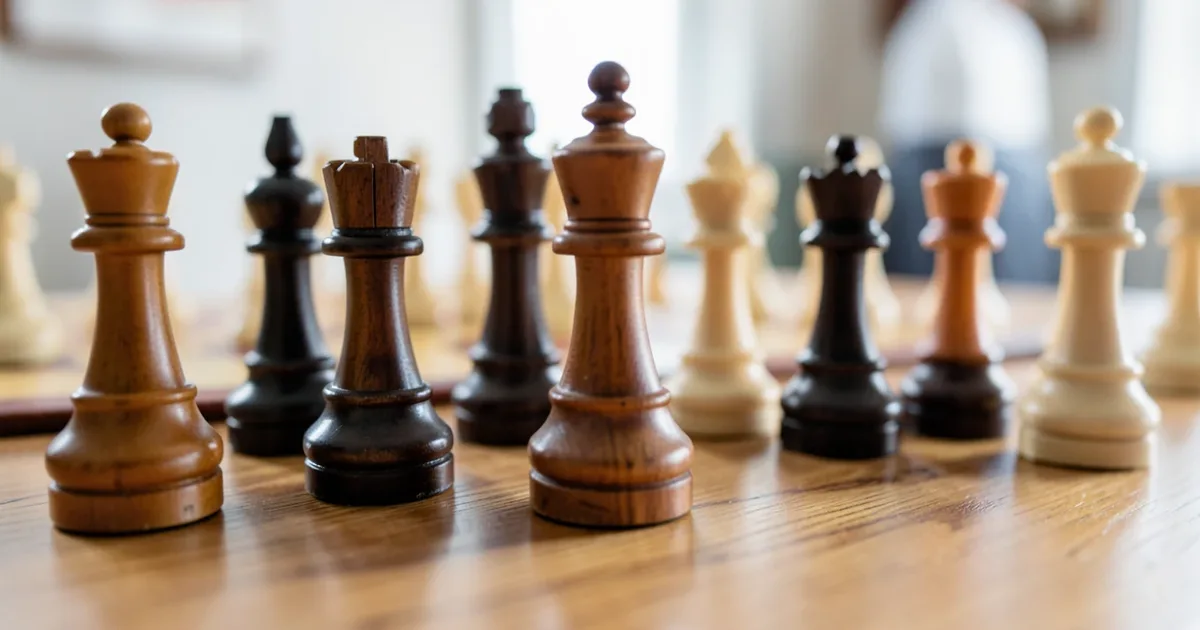
The values taught to beginners are a teaching tool, and a good one. A pawn is one, a knight and bishop are three, a rook is five, a queen is nine. They let a child decide whether a trade is sensible without calculating anything.
They are also not what any engine has used in thirty years.
The tuned numbers
Engines that stored explicit values, which is all of them before 2020, arrived at these through automated testing rather than theory:
| Piece | Beginner value | Typical engine value |
|---|---|---|
| Pawn | 1 | 1.0 |
| Knight | 3 | 3.2 |
| Bishop | 3 | 3.3 |
| Rook | 5 | 5.0 |
| Queen | 9 | 9.5 |
| Bishop pair | — | plus 0.5 |
Two of those differences change decisions. The bishop pair bonus means two bishops together are worth more than the sum of two bishops, which is why giving up a bishop for a knight has a cost the beginner numbers do not show. And a queen at 9.5 rather than 9 widens the gap in queen against rook and bishop: the round numbers make the queen a pawn better, the tuned ones about 1.2.
Why the values were never constant
Even in the era of fixed values, no engine applied them flatly. Every one adjusted by position through separate terms:
- A knight is worth more with pawns on one wing, less on an open board.
- A rook gains substantially on an open file and on the seventh rank.
- A bishop loses value when its own pawns sit on its colour.
- Pawns are worth far more the closer they get to promotion, and a passed pawn on the sixth can be worth a piece.
So the number was a starting point that the rest of the evaluation immediately modified. The apparent precision of 3.2 versus 3.3 was always less important than what the position did to those figures.
What neural evaluation changed
A network has no table of piece values. It was never given one and does not produce one. It maps a position to a number directly, and whatever it has learned about the worth of a knight is distributed across its weights rather than stored anywhere you could read.
You can measure implied values by setting up positions and removing pieces, and the answers you get are not constant. Remove a knight from a closed position and the network says one thing; remove it from an open one and it says something meaningfully different. That is not an inconsistency. It is the point.
What to keep using
The beginner values remain the right tool at the board for quick decisions, and no engine result should make you stop counting material.
Three adjustments are worth adding to them once you are past that stage:
- Treat the bishop pair as worth about half a pawn. It shows up constantly and the round numbers hide it.
- Value three minor pieces slightly above a queen rather than equal to it. The beginner numbers call it level at nine each; the tuned values put three minor pieces at about 9.7 to 9.9 against a queen's 9.5, and three coordinated pieces usually outplay a queen unless their own king is exposed.
- Stop counting entirely once a passed pawn reaches the sixth rank. At that point material is not the thing being decided.
Beyond those, the honest answer is that position beats material accounting, which is precisely what an engine's evaluation is trying to express and what a table of values never could.
Testing it yourself
The claim that values are positional rather than fixed is easy to check on an analysis board, and it is more convincing to see than to read.
Set up a position with a knight and a bishop on the board, note the evaluation, then remove the knight and note it again. The difference is what that knight is worth in that position. Repeat in a closed position with pawns locked on both wings, and again in an open one with two open files.
The two numbers will differ noticeably, often by half a pawn or more. Neither is the knight's value. There is no such thing as the knight's value, which is exactly the point that the beginner table has to hide in order to be teachable.
The trade that most often goes wrong
Rook and pawn against two minor pieces is where the round numbers mislead most consistently. Six against six looks balanced. In practice the two pieces are usually better, particularly before the endgame, because two attackers coordinate in ways one rook cannot.
Two pieces against a rook and two pawns is closer to genuinely level, and past that the pawns start to tell. If you find yourself calculating this trade at the board, the round numbers are giving you a false sense that it is a free decision.
Common questions
- What are the real chess piece values?
- Older engines used roughly 1 for a pawn, 3.2 for a knight, 3.3 for a bishop, 5 for a rook and 9.5 for a queen, with a bonus of about half a pawn for holding both bishops. Modern engines with neural evaluation do not store fixed values at all.
- Is a bishop really better than a knight?
- Slightly, on average across all positions, which is why the tuned numbers put it a fraction higher. In any specific position the answer depends on whether the position is open, whether there are pawns on both wings, and whether outposts exist. The average is not advice about your game.
Try it on your own position
The analysis board runs the same engine in your browser, free. The app adds what a web page cannot: reading a position straight from a photograph, saved boards, and analysis with no connection.